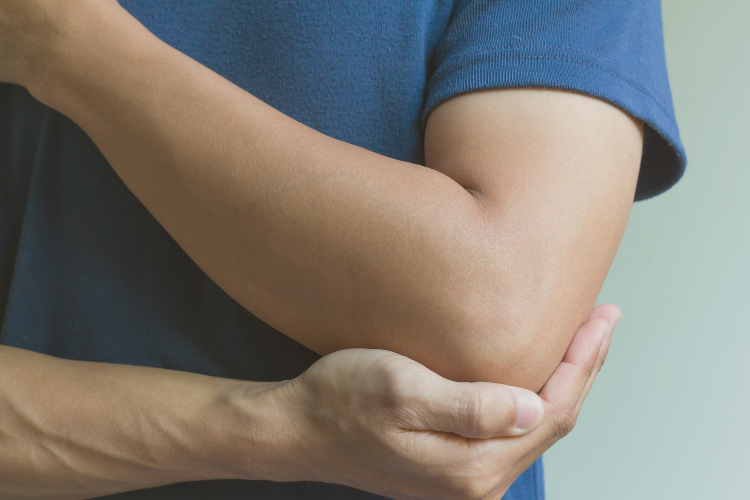
Your humerus is the only bone in your upper arm. A humeral shaft fracture is a break to middle portion of your upper arm bone. You may also break it at the top where it meets your shoulder (a proximal humerus fracture) or at the bottom where it meets your elbow (a distal humerus fracture).
Proximal humerus fractures are more common. The shaft of the humerus contains stronger bone that normally requires a considerable force to break it, such as a serious fall or vehicle collision. Humeral fractures account for fewer than 10% of all broken bones.
Because the radial nerve wraps around the upper arm and travels down to the arm, a humeral shaft fracture can also cause nerve damage. This may lead to weakness in the muscles of the hand and wrist which may make it difficult to pick up or carry things in the affected hand. You may also experience altered sensation across the back of the hand. Nerve damage is usually temporary and most patients recover within three or four months, but in many cases it takes much longer or requires surgery to aid recovery.

Causes of humeral shaft fractures
You may fracture your humeral shaft as the result of a heavy blow to that part of your arm, a motor vehicle collision or falling onto your outstretched hand. Injury can also occur as the result of twisting awkwardly or playing high impact sports which can lead to collisions or falls.
This injury is also sometimes seen in infants during childbirth. A humeral shaft fracture can be the result of a condition like osteoporosis which causes the bones to weaken and can result in sudden and unexpected fractures. Bone cancer can also cause your humerus to fracture.
Symptoms of humeral shaft fractures
Symptoms of a fractured humeral shaft include pain, swelling and bruising in the upper arm. You will have problems moving the affected arm and severe pain when you try. Your arm may appear deformed and if you have a displaced fracture the upper arm bone may appear shorter. If the radial nerve is affected, you may experience weakness in your hand and wrist or a loss of sensation in your arm below the fracture.
Diagnosis of humeral shaft fractures
Following a physical examination and discussion of how the injury occurred, you will normally be referred for an X-ray which will show up any breaks in the upper arm bone. If there is decreased sensation in the back of the hand or you cannot bend your hand backwards, this is an indicator of possible nerve damage.
Treating humeral shaft fractures
Significantly displaced fractures will need surgery to insert either a nail or a plate and screws to realign the broken sections of bone and hold them in place while the fracture heals. This is called internal fixation. The metal is compatible with your body and does not need to be removed, but in cases where is causing any irritation on the surrounding muscles and tendons then you it may be appropriate to remove it.
In humeral shaft fractures that have note healed without surgery, you may need bone grafting to re-join the fractured sections of bone. This involves taking a section of bone from another part of your body (normally your hip) or from a donor, or occasionally artificial bone substitute.
Possible complications of surgery to repair a humeral shaft fracture include infection, nerve or blood vessel damage, or the bones failing to grow back together properly. Your orthopaedic surgeon will discuss any possible risk with you prior to surgery.

Preventing humeral shaft fractures
While it may not be possible to prevent accidents, you can reduce your risk of humeral shaft fractures by wearing the correct protective equipment during high impact sports and always wearing a seat belt when driving. Eating a healthy balanced diet and exercising regularly can help you to maintain good bone health and if you have a family history of osteoporosis, you may be able to take a bone density test.
Contact us for information and advice about diagnosis and treating humeral shaft fractures.
Orthopaedic Consultant & Surgeon | London
Thames Shoulder & Elbow are able to provide advice and support to anyone experiencing symptoms affecting the upper limbs (shoulder, upper arm, elbow, forearm and wrist).
Telephone: 020 376 15987
Email: admin@thamesshoulderandelbow.co.uk
Our Locations
Hospital of St John and St Elizabeth, St John’s Wood – Directions
BMI The Syon Clinic, Brentford – Directions
HCA Chiswick Medical Centre, Chiswick – Directions
West Middlesex University Hospital, Chelsea and Westminster Foundation Trust, Isleworth – Directions